During week 9 Mrs Harris's literacy group did a project based on the Matariki Stars.
First, we watched a video of the stars. This prompted some discussion about Matariki and the solar system. We wrote down what we already know about Matariki on a sticky note. Many of us already knew what Matariki is and that there are 7 stars in the constellation.
Next, we did some research about the Matariki stars. We discovered that they all have different personalities and strengths. Mrs Harris told us to imagine what they would look like if they were human. We all chose our favourite Matariki star:
"My favourite one would probably be Tupu-a-rangi because she has the power of singing and also to heal animals and the forest" - Levi
"My favourite is Tupu-a-nuku because it's about all the nature and I like nature because when I was at preschool I always used to climb the trees" - Jahvi.
"My favourite would be Ururangi because she is basically the clouds that blow wind to everyone and make the weather happen" - Hanlin
"My favourite is Tupu-a-rangi because it's like songs and I love songs and birds" - Brady
"My favourite is Waipunarangi because she provides water for the world" - George
The next part of the project was all about art so we practised sketching our favourite star.
Finally, we talked about working together to create a Matariki masterpiece. Each of us had a different job to do. These were sketching, colouring in, sharing ideas, adding glitter and glue.
Below are some photographs of our stars. Can you tell which star is which by looking at our artworks?
Showing posts with label Reading. Show all posts
Sunday, 30 June 2019
Tuesday, 6 March 2018
Gangsta Granny by David Walliams
Those of us who are in literacy with Mrs Harris have been reading 'Gangsta Granny' by David Walliams.
We are about halfway through and we have completed a range of activities that relate to the novel.
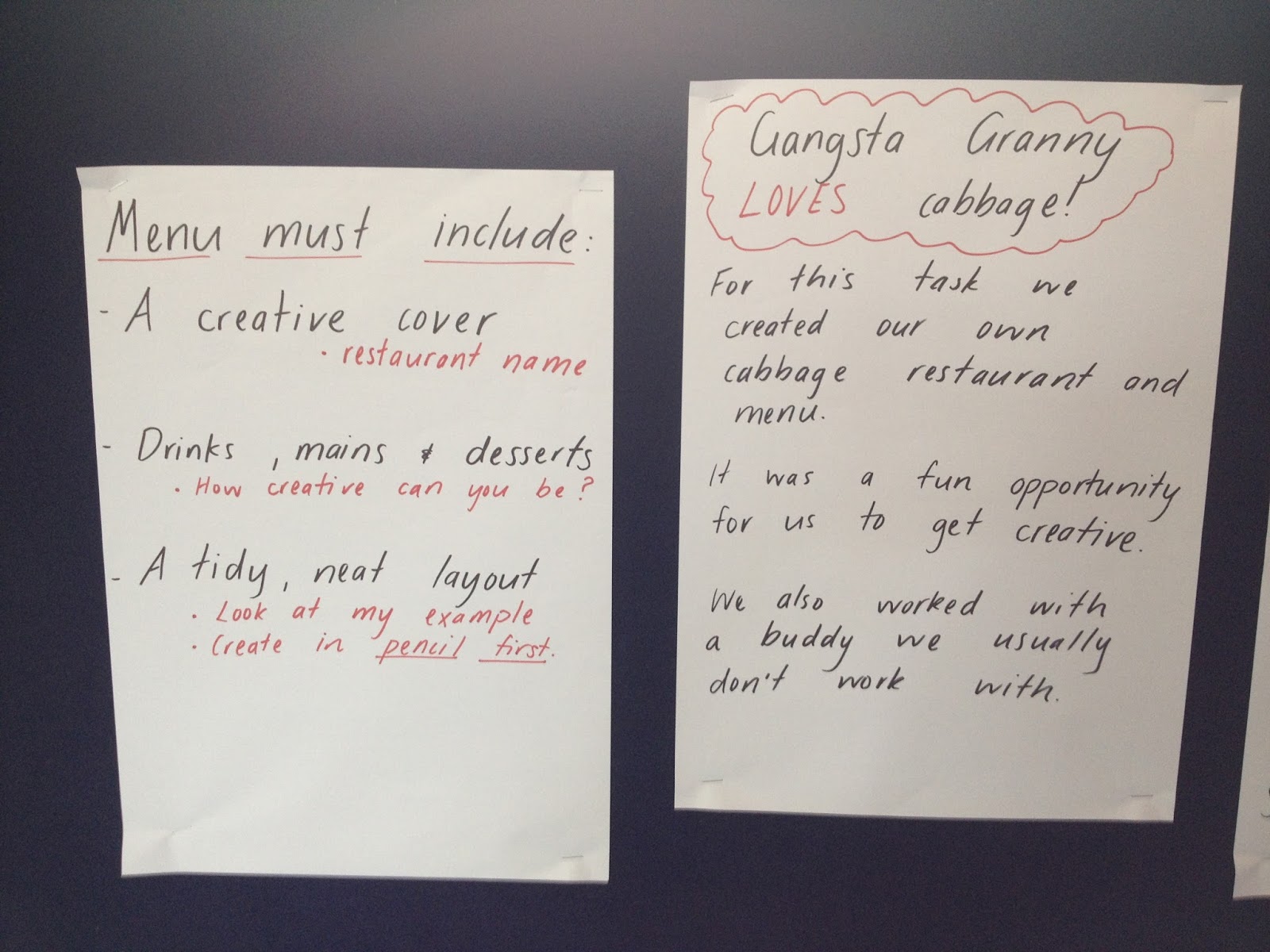
This week we started creating Gangsta Granny restaurant menus. Granny is obsessed with cabbage so we switched on our creativity and came up with a menu that is entirely cabbage related. This is what we needed to do to be successful at the task. We came up with this as a class.
We worked with a buddy or in groups of three. We are thinking about creating advertisements for our Gangsta Granny restaurants next week.


Tuesday, 20 February 2018
The Miraculous Journey Of Edward Tulane
Once there lived a china rabbit named Edward Tulane. The rabbit couldn't move or speak, but he could watch and listen, and he was very pleased with himself and his owner and his house. And then, one day, he was lost.
Those of us in Mr K's literacy groups have just finished reading this story. We started reading it in Week 2, have spent several literacy sessions writing to make connections to events in the story and have also examined the personality traits of the main character, Edward Tulane.
Wednesday, 30 August 2017
The General Election - What Are The Party Policies?
It has been a very interesting week learning so much about the upcoming election. We have received our kids voting ballot boxes in the mail.
After watching this video, we now know how to vote, but not all of us know who we want to vote for. We realised we need to find out more about what the parties all care about.
Here is more information about the kids voting programme.
After watching this video, we now know how to vote, but not all of us know who we want to vote for. We realised we need to find out more about what the parties all care about.
On Monday we split into small groups within our larger literacy groups. Each group was allocated a political party contesting the election, where they had to research what the party policies were (the policies are the list of things that each party say they will do after the election if they are in government).
Over the next couple of days, each group used Google Slides to collaboratively put together a presentation to share back with us. Mr K and Mrs Harris made it clear that we were not persuading people to vote for the parties, but simply explaining what their policies were.


Savannah said, "It was fun doing the research, because I already liked that party. It was good using Slides because we can share it with everybody in our own group and they could each do their own parts. I asked the group if I could do water policies and everyone agreed. Ava found out about a policy for getting kids to school safely and reducing rubbish and Kelli did some other policies. I was a bit nervous sharing back to the class with all those eyes looking at me!"
Yesterday we began coming up with ideas for policies we would try to campaign on if we were involved in a Bromley School election. We tried to think of things that would improve our community, either to address existing problems, or just new exciting ideas.
Next week we will be looking closely at some of our policy ideas. Could any of them be worth exploring further?...
Monday, 19 June 2017
Readers' Cafē - 2017 Update
Our Readers' Cafē is the time every Friday morning when we get together with our peers to share our personal reading books for the week. We have had 17 sessions so far in 2017 and as we are nearly half way through the year, this seems like a good time to reflect on how we are doing, how we can improve the systems we have and set some important goals for ourselves.
In essence, Readers' Cafē is run by the students. They choose their own books for personal reading, they organise themselves to read at school and at home (getting signed off by a parent or guardian) and they run the Friday morning sharing sessions.
During a Reader's Cafē session, students are organised into groups of 4-6 (usually decided by how many times they have won Readers' Cafe). One person is the observer. They facilitate the session by keeping each person to a time limit when sharing their book/s. They are also responsible for awarding points to group members for how well they share their books (max 3 points) and how well they listen and ask questions of others (max 2 points). At the end of every session, the observer announces the winner, who then becomes an observer the following week.
Something new we have introduced this year are digital badges for Readers' Cafē. These are proving to be motivating for students, with many already having earned the Level One badge. Students are displaying all of the digital badges they are earning (as their are badges for other achievements too) on their individual blogs.

Sunday, 14 May 2017
Kite Project - The Beginning
This week in Koru 1 two exciting projects began. We got to choose between a project on land yachts or kites. These projects will run over the next two weeks.
Both of these relate to our inquiry theme 'How Stuff Works'. We will be using our scientific minds to explore the physical world, for example movement and forces. We will be researching, designing, constructing and testing our wind powered projects over the next two weeks.
Today the kite group worked with Mrs Harris. We worked together to come up with a timeline for the project. This is going to help us keep on track and manage our time effectively.
We used our reading strategies to activate our prior knowledge about kites. We viewed some video footage of kite flying to get us inspired and thinking about our own designs. We realised not all kites are a diamond shape and that we will need light materials for our kite construction next week.
We also did some shared reading about the history of kites. While doing this we learned a simple note taking technique. This will help us when be begin our own research.
Our next step is to look at more of the science behind kite flying. How do kites fly? We can also begin gathering materials at home.
Subscribe to:
Posts (Atom)